
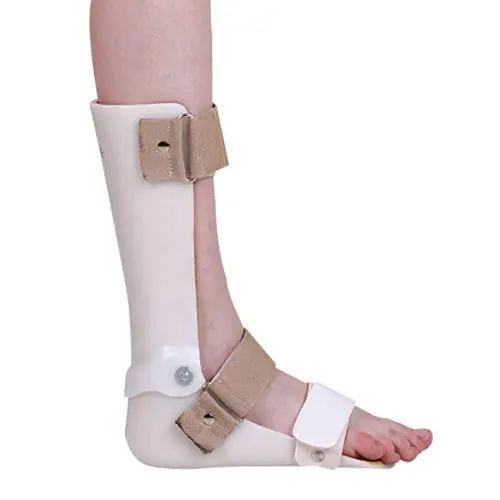
Articulated AFO
Key Features
- Hinged Ankle Joint for Physiological Movement
- Independently Adjustable Plantarflexion & Dorsiflexion Resistance
- Phase-Specific Gait Control Across All Three Rockers
- Thermoplastic Shell with Custom Moulded Fit
- Adjustable Initial Ankle Alignment Setting
- Suitable for Both Flaccid & Spastic Presentations
- Low-Profile Design for Standard Footwear Compatibility
Articulated AFO — Hinged Ankle Foot Orthosis for Dynamic Gait Rehabilitation & Neurological Lower Limb Support
The Articulated AFO represents a clinically advanced evolution in ankle foot orthosis design, bridging the gap between the rigid immobility of a solid AFO and the unrestricted movement of an unsupported limb. By incorporating a mechanical ankle hinge joint, this orthosis delivers the structural support necessary to correct pathological gait while preserving — and actively facilitating — the natural movement patterns that are essential to efficient, safe ambulation and successful long-term rehabilitation outcomes.
Why Articulation Matters: The Biomechanical Advantage
The human ankle joint performs a complex and phase-specific series of movements within every single step. During initial contact, the ankle must absorb impact and control foot lowering to prevent an audible, injurious foot-slap. Through mid-stance, it must allow the tibia to advance smoothly over a fixed foot. At terminal stance, it facilitates the critical push-off moment that propels the body forward. During swing, it must lift the forefoot sufficiently to clear the ground entirely.
A rigid, non-articulated AFO constrains all of these movements simultaneously, often creating secondary biomechanical problems such as knee hyperextension, hip hiking, and reduced walking speed. The Articulated AFO resolves this by delivering the right mechanical response at the right moment in the gait cycle preventing drop-foot during swing phase, permitting normal ankle motion during other phases, and assisting push-off in some cases making it far more consistent with physiological walking mechanics.
Individually Tunable for Precision Clinical Outcomes
The defining clinical advantage of the articulated design is the ability to adjust resistance independently for both plantarflexion and dorsiflexion directions. The ankle and knee angle and moment are responsive to changes in the AFO joint settings, meaning that a skilled orthotist or physiotherapist can iteratively fine-tune the brace to precisely match the patient's evolving neuromuscular capacity — increasing resistance where hypertonicity exists, reducing restriction where voluntary movement is returning, and progressing the prescription in line with rehabilitation milestones without requiring a new device.
The initial alignment angle can similarly be set to accommodate individual anatomical starting points. This provides the practitioner a more precise, simplified, and calibrated method of setting the optimal dorsiflexion or plantarflexion angle for the patient's foot and ankle complex, enabling a truly bespoke orthotic outcome from a pre-fabricated or custom-moulded platform.
Broad Clinical Applicability Across Neurological Conditions
The Articulated AFO is prescribed across a wide spectrum of neurological and musculoskeletal conditions. It is used to treat conditions including excessive pronation, heel inversion or eversion, forefoot abduction or adduction, and ankle instability as well as foot drop arising from stroke, spinal cord injury, peroneal nerve palsy, and multiple sclerosis. Its ability to manage both flaccid and mildly spastic presentations makes it one of the most versatile tools available to the prescribing orthotist.
For post-stroke patients in particular, the clinical evidence is compelling. Results have shown immediate improvements for walking speed, stride length, and angular changes of dorsiflexion of the paretic ankle joint during the gait cycle directly translating to safer, more confident community ambulation and meaningful improvements in patient independence and quality of life.
Custom Fit, Long-Term Durability & Daily Wearability
The thermoplastic shell is individually heat-moulded to the patient's limb, ensuring a precise anatomical fit that is both comfortable and biomechanically effective. The low-profile hinge joint and streamlined construction allow the AFO to fit inside most standard footwear, supporting seamless integration into everyday life. All materials are selected for durability, skin safety, and ease of maintenance — ensuring that clinical effectiveness is maintained throughout prolonged daily use.
Indicated For: Foot drop (flaccid and mild-to-moderate spastic), post-stroke gait rehabilitation, peroneal nerve palsy, multiple sclerosis, spinal cord injury, cerebral palsy, Charcot-Marie-Tooth disease, traumatic brain injury, ankle instability, excessive pronation, post-operative lower limb recovery, and patients requiring progressive, adjustable orthotic intervention.