
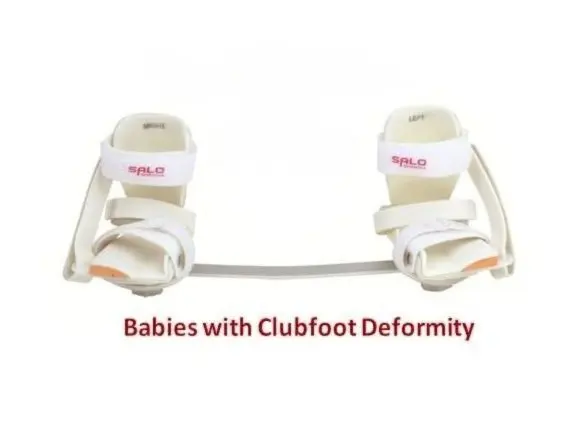
Dennis Brown Splint
Key Features
- Adjustable Aluminium Crossbar for Bilateral Foot Positioning
- Moulded Shoe Inserts for Anatomically Accurate Foot Capture
- Independent Rotation Adjustment on Each Side
- Proven Relapse Prevention in Post-Ponseti Management
- Full-Time to Nocturnal Wear Schedule for Long-Term Correction
- Suitable from Newborn Period Through Early Childhood
- Applicable Across Multiple Paediatric Foot Deformity Conditions
Denis Browne Splint — Paediatric Foot Abduction Orthosis for Congenital Clubfoot Correction, Post-Ponseti Maintenance & Deformity Relapse Prevention
The Denis Browne Splint, also known as the Denis Browne bar or foot abduction orthosis, is a medical device used in the treatment of clubfoot, named after Sir Denis Browne (1892–1967), an Australian-born surgeon at Great Ormond Street Hospital in London who was considered the father of paediatric surgery in the United Kingdom, who first described the device in 1934. AmazonDecades of clinical application and research have since cemented its place as one of the most widely used and clinically validated orthotic devices in paediatric orthopaedics — an enduring solution to one of the most prevalent congenital musculoskeletal conditions affecting newborns worldwide.
Understanding Congenital Clubfoot & the Rationale for Splinting
Congenital Talipes Equinovarus (CTEV), commonly known as clubfoot, is a complex three-dimensional foot deformity characterised by the four components of equinus, hindfoot varus, forefoot adduction, and cavus. If left unmanaged, it leads to a painful, functionally compromised foot that is profoundly disabling throughout the child's life. The internationally accepted Ponseti method — comprising serial manipulation, casting, and percutaneous Achilles tenotomy — achieves reliable initial correction of these deformity components in the vast majority of cases. However, the biological tendency of the immature foot to revert towards its original position remains significant throughout infancy and early childhood, and correction achieved through casting alone cannot be sustained without a dedicated post-casting bracing programme.
This is the precise clinical role of the Denis Browne Splint. The Denis Browne Splint with a well-moulded heel is an effective orthosis to maintain clinical and radiological results after initial treatments, especially when it is applied at an early age. RcaiBy holding both feet simultaneously in the externally rotated, dorsiflexed position equivalent to that achieved in the final corrective cast, the splint continuously applies the corrective forces required to guide the developing foot bones, ligaments, and tendons into their correct anatomical relationships as growth proceeds.
The Mechanical Principle: Bilateral Abduction Through a Fixed Crossbar
The Denis Browne Splint operates on a straightforward but biomechanically elegant mechanical principle. The rigid aluminium crossbar functions as a fixed-width spacer between the two feet, preventing them from being brought together and maintaining both lower limbs in a position of hip abduction. The foot plates attached at each end of the bar are set at a prescribed external rotation angle — typically 60–70 degrees on the affected side and 30–40 degrees on the unaffected side in unilateral cases — ensuring that the foot is held in the precise degree of abduction recommended by the treating orthopaedic surgeon or orthotist. The child's own leg movements and kicking generate dynamic corrective forces through the crossbar mechanism, meaning that normal infant activity actively contributes to the therapeutic process rather than working against it.
Compliance: The Defining Factor in Long-Term Success
The leading cause of relapse and recurrence is nonadherence to the Denis Browne bracing protocol Brace Direct— a finding that underscores the critical importance not only of prescribing the splint but of ensuring that the device is comfortable, well-tolerated, and easy for families to use correctly at home. The moulded shoe inserts or boots that secure each foot within the splint are designed to hold the foot securely without causing pressure sores or skin irritation — the most common physical barrier to consistent wear. The adjustable crossbar allows straightforward reconfiguration as the child grows, reducing the frequency of clinical visits required for splint modifications and minimising the practical burden on families during what is already a demanding period of care.
Clinical Evidence Supporting Effectiveness
The clinical evidence base for the Denis Browne Splint spans decades of peer-reviewed research. Using a modified Denis Browne splint with an aluminium crossbar holding a pair of plastic shoe inserts moulded into corrected positions, treatment was started in children aged four weeks to nine months, with all treated feet demonstrating excellent or good function, and radiographic assessment confirming that equinus, adduction, varus, and cavus deformities had all been well corrected. SaloorthoticsThese outcomes reflect the splint's capacity — when used consistently and correctly — to deliver the sustained positional correction that the developing paediatric foot requires to remodel into a functional, pain-free structure.
Broader Applications Beyond Idiopathic CTEV
While the Denis Browne Splint is most closely associated with post-Ponseti clubfoot management, its clinical utility extends to a range of related paediatric foot conditions. It is indicated for metatarsus adductus, internal tibial torsion, congenital vertical talus, and post-surgical foot positioning following soft tissue release or tendon transfer procedures — anywhere that bilateral or unilateral external rotation positioning of the infant foot is required to correct, maintain, or prevent deformity during the critical period of early skeletal development.
Indicated For: Congenital talipes equinovarus (idiopathic, syndromic, and neurogenic), post-Ponseti serial casting maintenance, post-Achilles tenotomy foot positioning, metatarsus adductus, internal tibial torsion, congenital vertical talus, post-operative paediatric foot positioning, and prevention of clubfoot deformity relapse in infants and young children.