
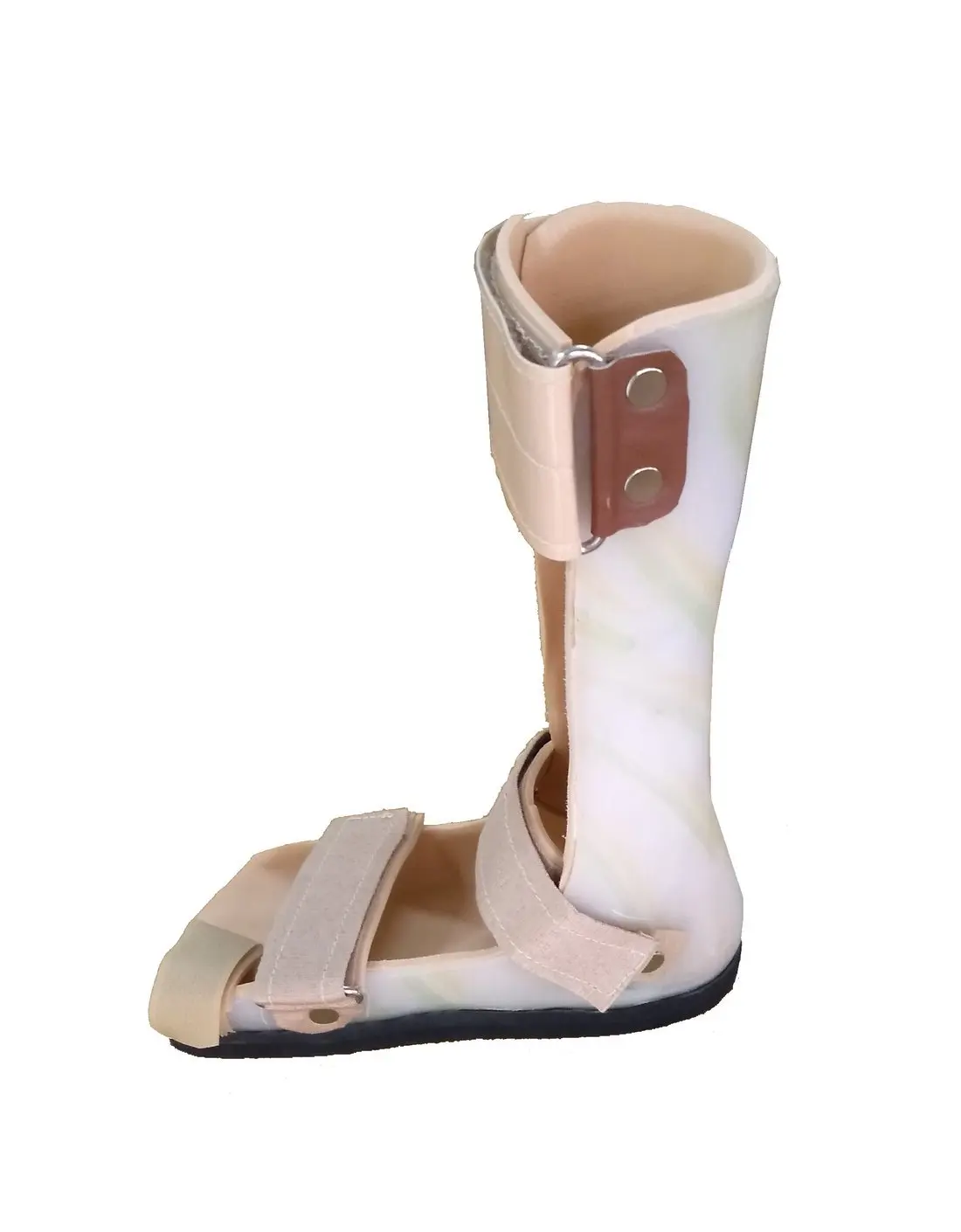
Static AFO
Key Features
- Solid Fixed-Ankle Design for Complete Joint Immobilisation
- Thermoplastic Shell Custom-Moulded to the Patient's Limb
- Trimline Positioning for Mediolateral Stability Control
- Heel-to-Toe Gait Pattern Restoration
- Knee Posture Regulation via Ground Reaction Forces
- Dual-Purpose Use for Ambulation & Contracture Prevention
- Lightweight, Hygienic & Easy to Don and Doff
Static AFO — Solid Ankle Foot Orthosis for Reliable Foot Drop Management, Ankle Stability & Neurological Gait Rehabilitation
The Static AFO (Solid Ankle Foot Orthosis) is one of the most clinically established and widely prescribed orthotic devices in lower limb rehabilitation. Designed to deliver consistent, fixed-position ankle control without any mechanical joint movement, this orthosis is the device of choice when maximum stability, reliable foot drop correction, and firm mediolateral ankle control are the primary clinical objectives. Its straightforward yet highly effective design has made it a foundational tool in orthotic practice across neurological rehabilitation, post-traumatic recovery, and long-term musculoskeletal management.
The Clinical Rationale for a Solid, Non-Articulated Design
The solid ankle type AFO is predominantly applied to completely limit ankle joint movement in patients with foot drop, weak dorsiflexion and/or plantarflexion, ligament injury about the ankle, mild knee instability, and valgus/varus deformity. Unlike articulated or posterior leaf spring designs, the static AFO makes no concession to ankle motion — it holds the joint firmly in a clinician-defined neutral position throughout every phase of the gait cycle. This total restriction approach is most appropriate when the severity of the patient's neuromuscular deficit, joint instability, or deformity demands absolute, uncompromising orthotic control rather than assisted or partially restricted movement.
Foot Drop Correction & Safe Ambulation
The AFO prevents the foot from being dragged, provides clearance between the foot and the ground in the swinging phase of gait, and maintains a stable posture by allowing heel contact with the ground during the stance phase For patients managing foot drop arising from stroke, peroneal nerve palsy, spinal cord injury, or other neurological conditions, this translates directly into a safer, more controlled walking pattern — eliminating the dangerous toe-catching and compensatory hip-hiking that significantly elevate fall risk and increase energy expenditure during ambulation.
Mediolateral Stability: A Critical Design Advantage
A key structural advantage of the solid AFO over more flexible alternatives is its superior mediolateral stability. The trimline is positioned anterior to the malleoli on both sides, encapsulating these bony landmarks within the orthosis and delivering firm rotational and frontal plane control. This makes the static AFO particularly effective in managing ankle valgus, varus deformity, and the combined instability patterns frequently encountered in post-stroke hemiplegia, cerebral palsy, and chronic ankle ligament insufficiency — conditions where a flexible or posterior leaf spring design would provide insufficient control.
Secondary Knee Management Through Ankle Positioning
An often underappreciated clinical advantage of the static AFO is its capacity to influence knee joint mechanics indirectly. By fixing the ankle at a specific angle, the orthosis modifies the direction and magnitude of ground reaction forces acting on the knee during the stance phase of gait — enabling clinicians to address secondary problems such as knee hyperextension (genu recurvatum), excessive flexion (crouch gait), or lateral thrust without requiring an additional knee orthosis in many cases. This multi-joint effect significantly enhances the clinical value of what appears at first to be a single-joint device.
Contracture Prevention: Day and Night Application
When AFOs are used throughout the day and night and provided early in the disease process, the patient's ability to ambulate can be prolonged. In progressive neurological conditions such as multiple sclerosis, motor neurone disease, and muscular dystrophy, consistent orthotic positioning — both during walking and overnight — is a clinically critical strategy for preserving soft tissue extensibility, delaying the onset of fixed plantarflexion contracture, and maintaining functional ambulation for as long as possible.
Fabrication, Fit & Everyday Practicality
The static AFO is fabricated from thermoplastic sheeting — typically polypropylene — that is vacuum-formed over a positive plaster model of the patient's limb, resulting in a device that precisely replicates the individual anatomy of the lower leg and foot. The resulting orthosis is lightweight relative to its structural rigidity, fully washable, and designed to fit inside appropriately selected footwear. Secure Velcro calf straps allow straightforward independent application and removal, supporting patient independence in daily living — a fundamental goal of effective orthotic management.
Indicated For: Foot drop (flaccid), post-stroke hemiplegia, peroneal nerve palsy, spinal cord injury, multiple sclerosis, cerebral palsy, traumatic brain injury, Charcot-Marie-Tooth disease, ankle ligament insufficiency, ankle valgus and varus deformity, mild knee instability, genu recurvatum, plantar flexion contracture prevention, and post-operative lower limb stabilisation.